
How we built DC Rally
Your Game. Your Coach. Your AI Advantage. AI-powered badminton intelligence: a parent records a match on one phone, and DC Rally reads every serve, point, shot and movement, then turns it into a match report, a coach’s view and answers in plain language.
- Built and owned by
- Decision Culture
- Sector
- Youth sport, academies
- Platform
- Databricks lakehouse
- Status
- Academy pilot starting Nov 2026
Measured on our test matches against hand-checked truth. A separate set of matches is sealed for the final test and has never been used for tuning, so the pilot numbers will be reported on matches the system has never seen. On held-out matches during development, the server was read right 91% of the time and the winner 85%.
Junior players are filmed all the time. Almost nobody analyses the footage.
Parents of competitive junior players record nearly every match on their phones. The videos sit in camera rolls. A coach has no time to watch hours of footage for every child, and professional match analysis needs fixed multi-camera systems that only top venues can afford.
We set out to give every family and academy the kind of match intelligence that elite players get, from the phone they already own. It had to work at a club court on a Saturday, recorded by a parent, with the result back within 24 hours.
Why this is hard
The same problems any real-world AI system meets: imperfect inputs, noise, and conditions that change every time.
One camera, set low
A phone behind the court sees the near player clearly and the far player small, so depth has to be inferred, not measured.
A tiny, very fast object
The shuttle is a few pixels wide, blurs at speed and disappears against lights and walls.
Busy halls
Neighbouring courts, other shuttles, and coaches sitting right behind the players all look like players to a model.
Real-world video
Phone footage arrives with variable frame rates, HDR, camera drift and cuts. Every match is different.
From one phone video to a full match read
Six stages, run automatically after the parent presses Start analysis. The parent’s only technical step is tapping four points on the court.
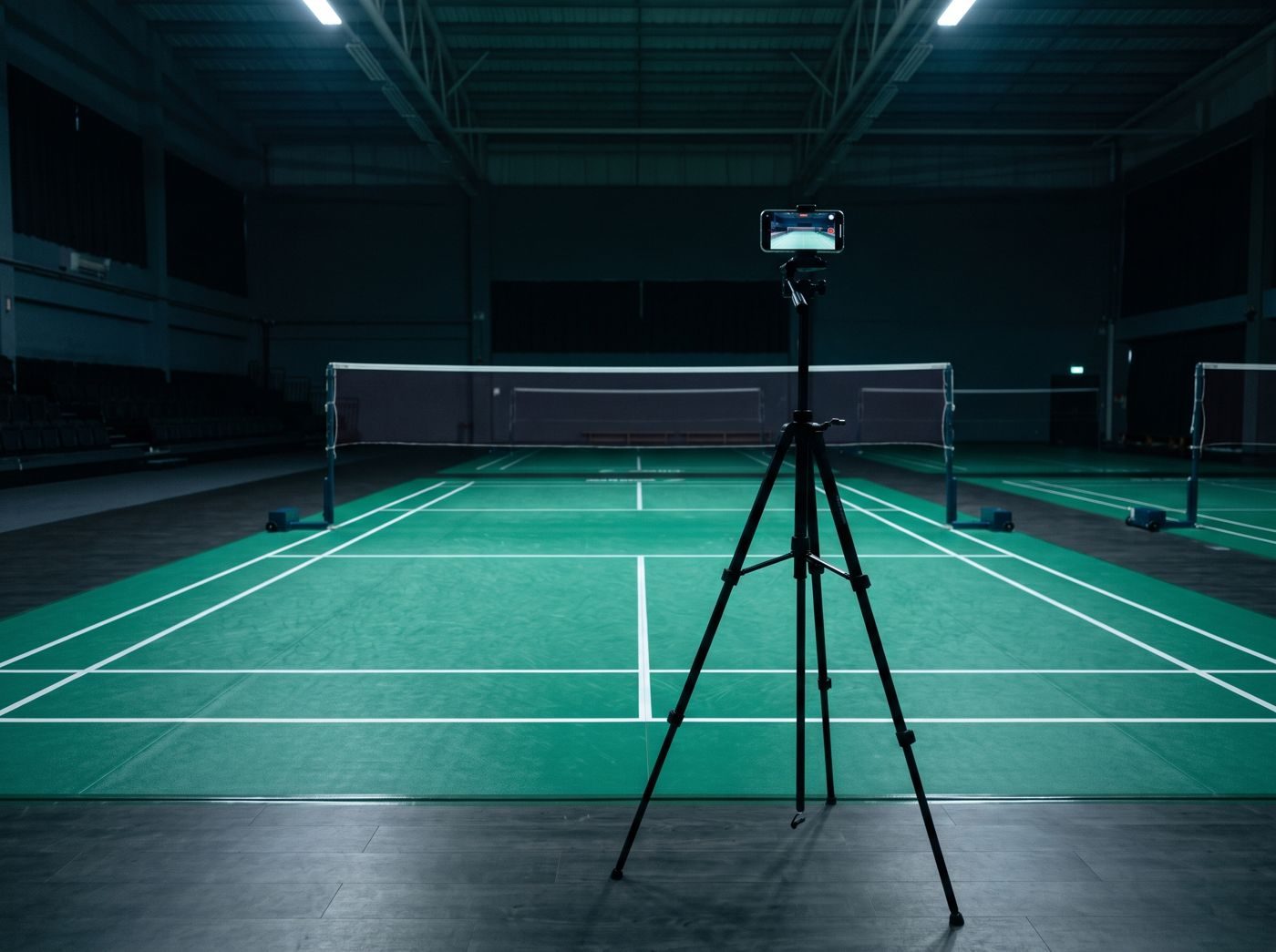
- ParentRecord and uploadPhone on a tripod, head height or above, behind the court.
- ParentMark the courtFour taps on the front service line corners map the video to real court metres.
- AISee the playComputer vision tracks both players’ bodies and the shuttle in every frame.
- AIRead the matchHits, rallies, serves and points, checked against the rules of the score.
- LakehouseStore and governRaw, cleaned and report tables, each family’s data kept apart.
- AppReport and askMatch report, coach comparison and Ask the Coach answers.
Six corners. Where the player was when each shot was struck. The back-left corner stands out: 19 shots, the most pressure came there.
A match report a parent understands and a coach can act on
- Match report: score by game, who served and who won every point, points won on serve and on receive, distance covered, rally lengths.
- Court maps and rally replay: where each shot was played from, how the player moved and how quickly they got back to base.
- Coach view: a coach invited by the family compares the players in their group over time. Numbers only: coaches never see the videos.
- Ask the Coach: questions in plain language, answered from that child’s match data, never from guesswork.
- Body at the shot In development the real frame at each lunge, overhead and ready position, with stance and reach measured, for the coach to judge.
A complete AI product, built end to end by Decision Culture
What we built, layer by layer.
Computer vision
Deep-learning models find both players’ bodies (17 joints each) and the shuttle in every frame, then follow the court if the camera drifts.
- Pose tracking at 30 frames a second
- Shuttle tracking that fills short gaps where it is hidden
- A zoomed second pass for the far player
Reading the game
A chain of models and rules turns tracks into badminton: each hit, each rally, who served, who won the point and what shot was played.
- Score-aware decoding: every point must agree with the rules of the score
- Shot type shown only when the model is sure
- Court geometry in real metres from four taps
Databricks lakehouse
Each match moves through raw, cleaned and report tables with automated jobs and a monitor that flags anything unusual.
- Unity Catalog governance and per-family row filters
- Test and production fully separated
- Promotion only after a same-results check
Parent and coach apps
A web app turns the report tables into a match report for the family and a comparison view for the coach, on laptop and phone.
- Match details and court marking in the app
- Phone camera check before recording
- Sign-in, with each family seeing only its own data
Ask the Coach
Questions in plain language are turned into queries on that family’s own match data, so every answer can be traced to the numbers.
- Answers grounded in governed tables
- Released only after passing a fixed 30-question answer key
- Each family can only query its own child
Governance and monitoring
Every match is checked automatically for signs that a reading went wrong, and the family sees a caveat instead of a confident wrong number.
- Score cross-checked with what the parent enters
- Warnings for camera, court and serve-side problems
- A monitor across every processed match
Built like a product that families will trust, not a demo
The same engineering discipline we bring to client work, applied to our own product.
Sealed test matches
A set of matches is locked away and never used for tuning. Final accuracy is measured only on them, so the numbers we report are the numbers a new family will see.
The bar is set before the result
Every experiment has its pass mark written down before it runs. A change that misses the bar is not shipped, however close it came.
Same results before any switch
A new version replaces the old one only after both run on the same matches and the differences are explained point by point.
Test and production apart
All work happens in a separate test environment. Production changes only by a planned promotion with a rollback path.
Ground truth by hand
Hundreds of points and shots were checked by hand against the video, so every accuracy figure has a real reference behind it.
Every decision written down
Each stage has a design document recording what was tried, what failed, and why the current approach was chosen.
The same capabilities, applied to your business
DC Rally turns messy raw signal into decisions people trust. That is the work we do for clients, whether the signal is video, machines or customers.
| In DC Rally | In your business |
|---|---|
| Computer vision on phone video | Quality inspection on a production line, shelf and store audits, safety monitoring from existing cameras |
| Reading hits, rallies and points from raw tracks | Turning clickstream, sensor or transaction events into journeys, funnels and outcomes you can measure |
| Databricks lakehouse with test and production apart | One governed source of truth for marketing, sales and operations data, promoted safely |
| Ask the Coach | GenAI assistants that answer business questions from your own governed data, with every answer traceable |
| Per-family access and children’s privacy | Role-based access, consent and compliance designed in from day one |
| Sealed tests and pre-set bars | Models you can defend in front of a CFO, measured honestly before they go live |
The same pipeline that reads a rally can read a production line or a sales funnel.
Children’s data handled with care
- Videos stay private to the family. Nothing is published or shared.
- Each family sees only its own child, enforced in the data layer and tested.
- Coaches see numbers only, never videos or pictures, and only when the family invites them.
- No child’s image or name is used in marketing.
- All data lives in one governed lakehouse, with test and production kept apart.
Our own methods, owned by Decision Culture
DC Rally’s code, models and data pipeline belong to Decision Culture. Several parts of the architecture are being evaluated for a patent filing, including:
- Court calibration from four taps on a phone video, with a check of the camera’s height and view before recording.
- Identifying the server of each point from body, racket and shuttle evidence, with confidence-based acceptance.
- Reading points so that they always agree with the rules of the score.
Starting with junior badminton, built to grow
The first customers are families of competitive junior players and the academies that train them: people who already film matches and want to improve faster. A subscription per player keeps it affordable; academies bring groups of players at once.
Academy pilot
- Live demo to a partner academy
- Invitation-only pilot with families
- Match report, court maps, server and winner of every point
- Accuracy reported on sealed matches
Scale the service
- Video processing on Databricks serverless GPU, started by the upload itself
- Coach comparison view and Ask the Coach in the app
- Body at the shot: technique snapshots with measurements
- Models that learn each player’s style as more matches arrive
New formats and sports
- Full far-player tracking from raised camera setups
- Doubles
- Tournament and fixed-camera recordings
- Other racket sports on the same platform
See DC Rally, or build your own
Explore the product at dcrally.ai, or talk to Decision Culture about turning your data into decisions with the same approach.
Client case studies
Finding the drivers of churn for a US telecom provider
Churn segments and models that showed a telecom client why customers were leaving, and where to act first.
Read the case study →Fixing leaky website journeys for a telecom eCommerce team
Clickstream path analysis that found where visitors dropped off, raising conversion and satisfaction.
Read the case study →SKU-level forecasts a retailer could share with its vendors
Time-series forecasts for 2,000+ SKUs that cut both stock-outs and overstock.
Read the case study →