
Four practices that take you from raw data to better decisions
We started in 2013 as a data science firm. Today we also build the platforms underneath the models, the AI that explains them, and the software that puts them in front of decision-makers.
Our practices
Data Engineering & Platforms
We build the data foundation your analytics and AI depend on: clean pipelines, governed lakehouses and dashboards people trust.
Explore Data Engineering →Analytics & Data Science
Our core since 2013: statistical and machine learning models that answer specific business questions, from pricing to churn to credit risk.
Explore Analytics & Data Science →AI & GenAI New
AI agents and assistants that use your own models and documents to answer questions, with every number traced to its source.
Explore AI & GenAI →Full-Stack Product Engineering New
Web apps and SaaS products that put models into the hands of the people who make decisions. We built and run our own SaaS, DCHire.
Explore Full-Stack Engineering →Data engineering, BI, data science and AI around a single process
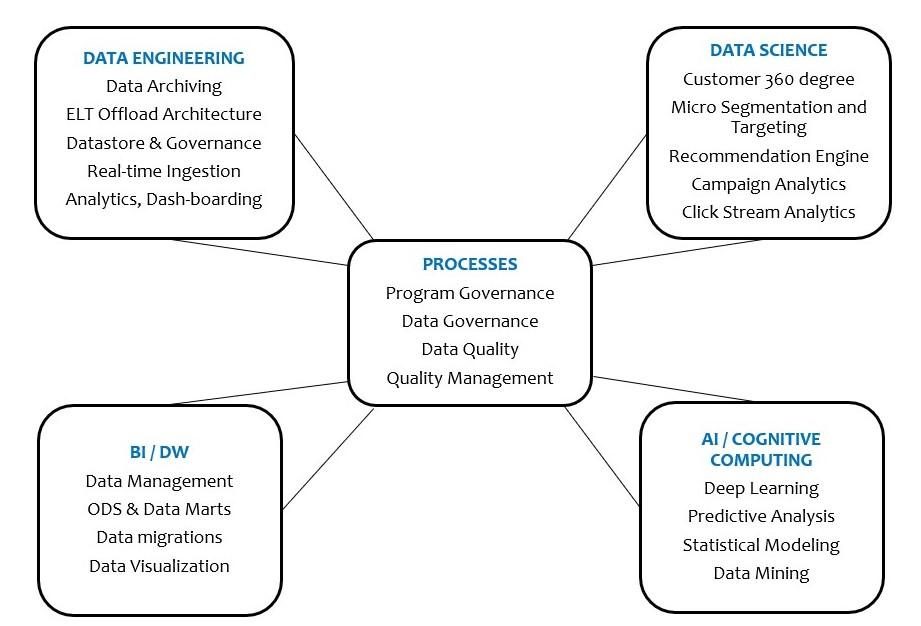
Our work has always spanned the full chain: data engineering underneath, BI and data warehousing for reporting, data science for prediction, and AI and cognitive computing on top. A shared process of governance, data quality and project management holds it together.
The four practices on this page are the same chain, updated for GenAI and product engineering.
Where are you on the analytics maturity curve?
Most organisations sit between stages 1 and 3. Each practice is built to move you up a stage, from ad-hoc reporting to AI-driven decisions.
- Focus
- Basic reporting, static dashboards, historical accounting
- Tech stack
- Excel, manual CSV exports, disparate tools
- Challenges
- Data duplication, inconsistent definitions, manual errors
- Focus
- Drill-down reporting, root-cause analysis, interactive dashboards
- Tech stack
- Central data warehouses (Snowflake, BigQuery), standard BI (Power BI, Tableau)
- Challenges
- Heavy reliance on central data teams, reporting bottlenecks
- Focus
- Churn prediction, demand forecasting, customer lifetime value, risk scoring
- Tech stack
- Modern data stack, SQL, Python or R, ML orchestration, feature stores
- Challenges
- Operationalising models: the gap from prototype to production
- Focus
- Decision automation, optimisation algorithms, dynamic pricing, real-time engines
- Tech stack
- ML pipelines, MLOps, real-time streaming (Kafka), A/B testing frameworks
- Challenges
- Building trust in algorithmic decision-making
- Focus
- Hyper-personalisation, autonomous supply chain, GenAI agents
- Tech stack
- Advanced AI/ML infrastructure, event-driven architecture, automated governance
- Challenges
- AI safety and alignment, model drift monitoring, ethical governance
How you can work with us
Project delivery
A defined problem, scope and outcome. Typical for a pricing engine, a forecasting model or an AI pilot.
Discuss a project →Managed Teams
You direct a full-time team in India; we employ it and handle compliance, payroll and infrastructure.
How it works →Build-Operate-Transfer
We build and run your team, then transfer people, assets and IP to you at an agreed time.
See the model →GCC in India
Your own Global Capability Center in Bengaluru, set up with our three-phase approach.
Plan your GCC →Have a decision you want to get right?
Tell us the decision, the data you have and the timeline. We will come back with how we would approach it.